Improving the Quality of Life and Public Health of Vulnerable Groups after Flash Floods in Pandai Sikek Village
DOI:
https://doi.org/10.25077/jwa.32.3.357-366.2025Keywords:
Post-disaster, Quality of Life, Vulnerable GroupsAbstract
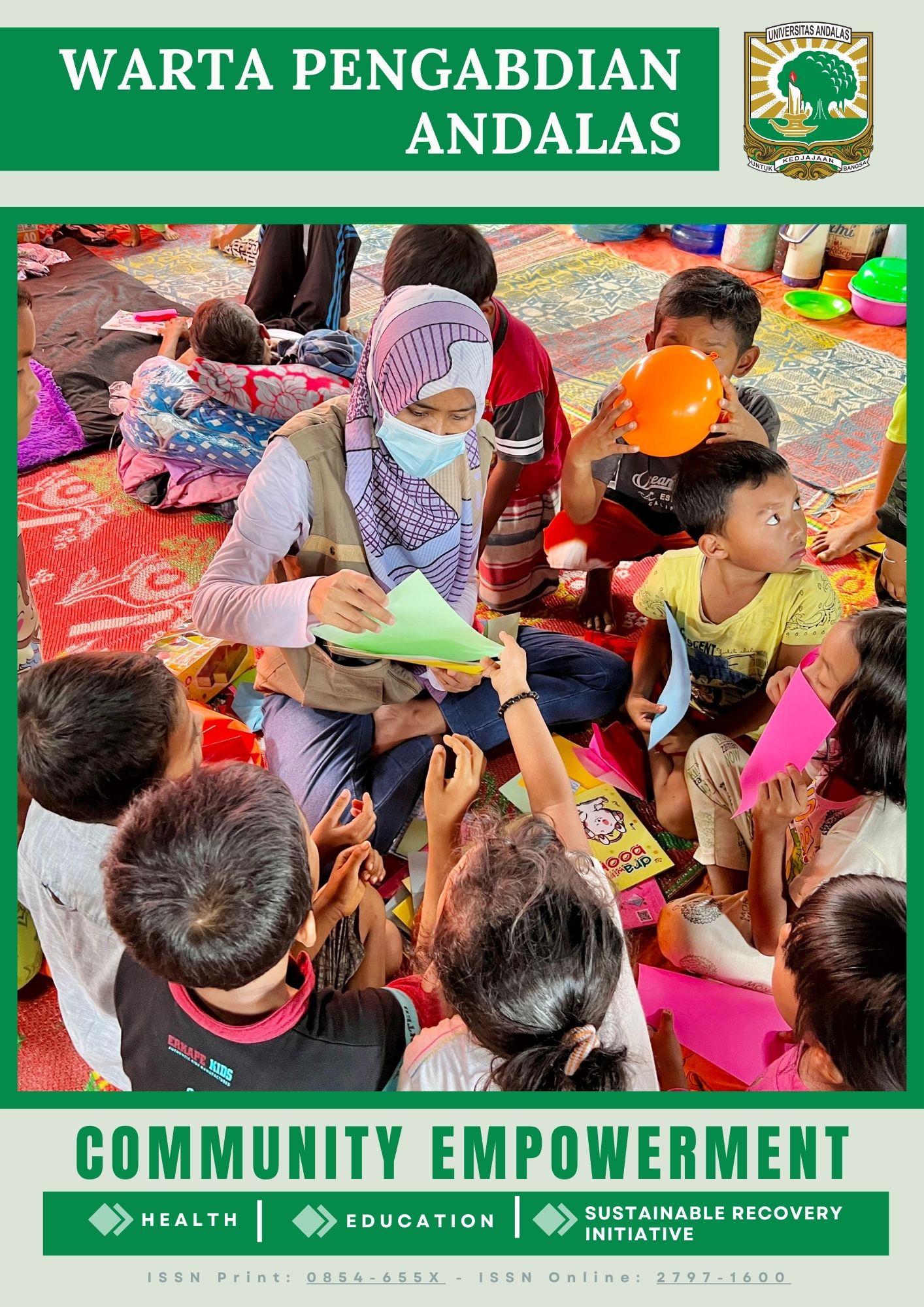
Nagari Pandai Sikek West Sumatra experienced a flash flood disaster that caused infrastructure damage, disruption of basic services, and decreased the quality of life of the community, especially vulnerable groups. This activity aims to improve the quality of life and health of post-disaster communities through an integrated approach in the fields of health and disaster management. The quality of life of the community is measured through a composite approach that includes knowledge improvement (pre- and post-tests), behavioral changes and participation in activities, simple health conditions (blood pressure and physical activity), waste bank and maggot-based environmental management, and community social involvement. These indicators show improvements in physical, cognitive, social, and environmental aspects after the community service activities. Activity methods include socialization, simulation, and education with a pre-test and post-test approach to measure the effectiveness of the intervention. Activities were carried out in the form of disaster mitigation counseling for elementary school students, maggot-based waste management training, healthy lifestyle counseling for the elderly through the GERMAS program, and nutrition education for parents related to stunting prevention. The results of the activity showed an increase in public understanding of disaster mitigation, with an average pre-test score of 58.4 increasing to 82.7 in the post-test. The community demonstrated a better understanding of the importance of waste management to prevent environmental pollution, awareness of early detection of hypertension, and the fulfillment of balanced nutrition to prevent stunting. Active participation in simulations, question and answer sessions, and discussions were indicators of the success of the activity. It can be concluded that this community service program succeeded in increasing the understanding and awareness of the Pandai Sikek community regarding health and disaster preparedness. The sustainability of this program needs to be supported through collaboration with local governments, educational institutions, and local communities to expand its positive impact.
Downloads
References
A. Sasarari, Z. et al. (2024) ‘Physical activity as an effort to prevent hypertension in the elderly’, Jurnal Edukasi Ilmiah Kesehatan, 2(1), pp. 26–32. Available at: https://doi.org/10.61099/junedik.v2i1.37.
Anwar, R.K. and Rizal, E. (2018) ‘Socialization practices of disaster mitigation for school children: A study in West Bandung regency’, AIP Conference Proceedings, 1987(July). Available at: https://doi.org/10.1063/1.5047327.
Azrimaidaliza, A., Khairany, Y. and Putri, R. (2020) ‘Edukasi Ibu Hamil Dan Balita Dalam Upaya Pencegahan Stunting Di Wilayah Kerja Pusksmas Pauh Kota Padang’, Buletin Ilmiah Nagari Membangun, 3(4), pp. 332–341. Available at: https://doi.org/10.25077/bina.v3i4.272.
Columbia Climate School National Center for Disaster Preparedness (no date) Vulnerable Populations.
Departement Health and Human Service USA (2021) Disaster Technical Assistance Center Supplemental Research Bulletin Greater Impact: How Disasters Affect People of Low Socioeconomic Status.
Department of Health and Human Services (2019) Predicting Environmental Health Risks for Post-Disaster Recovery August 2019.
Inang Prambudi, D. (2018) ‘Integrating Disaster Mitigation Education in the Elementary School Curriculum’, 147(Icsse 2017), pp. 79–82. Available at: https://doi.org/10.2991/icsse-17.2018.19.
Izzalqurny, T.R. et al. (2025) ‘Assistance in Organic Waste Management Using Maggots, Biopores, and Composters in Jatirejoyoso Village’, Jurnal Pengabdian Masyarakat, 6(1), pp. 188–195. Available at: https://doi.org/10.32815/jpm.v6i1.2408.
Oliveros, E. et al. (2020) ‘Hypertension in older adults: Assessment, management, and challenges.’, Clinical cardiology, 43(2), pp. 99–107. Available at: https://doi.org/10.1002/clc.23303.
Pujiatun, P., Zahra, A. and Nurdiati, D. (2023) ‘Health-related quality of life of the elderly after natural disasters: a scoping review’, Journal of the Medical Sciences (Berkala Ilmu Kedokteran), 55. Available at: https://doi.org/10.19106/JMedSci005502202310.
Shah, M.A.R. et al. (2020) ‘A review of hydro-meteorological hazard, vulnerability, and risk assessment frameworks and indicators in the context of nature-based solutions’, International Journal of Disaster Risk Reduction, 50, p. 101728. Available at: https://doi.org/https://doi.org/10.1016/j.ijdrr.2020.101728.
Sitepu, E.A.B. et al. (2019) ‘Pemanfaatan Dan Pengelolaan Bank Sampah di Kawasan Nagari Simpang Untuk Mewujudkan Nagari Yang Bersih, Nyaman dan Sehat’, Buletin Ilmiah Nagari Membangun, 2(2), pp. 304–312.
Wahyuni, D. (2021) ‘INVOLVEMENT OF VULNERABLE GROUPS IN THE CONTEXT’.
Water and Sanitation Program (2011) Economic Impacts of Inadequate Sanitation in India. New Delhi.
Wirayudha, G., Ilmi, I.M.B. and Marjan, A.Q. (2024) ‘Analysis of Risk Factors Contributing to Hypertension in Pre-Elderly and Elderly Populations in the Kedaung Subdistrict, Depok, Indonesia’, Amerta Nutrition, 8(3SP), pp. 269–274. Available at: https://doi.org/10.20473/amnt.v8i3SP.2024.269-274.
World Health Organization (2023) Chapter 3.2 Disaster risk factors – hazards, exposure and vulnerability.
World Health Organization (no date) Water, sanitation and hygiene: burden of disease, WHO.
Downloads
Published
How to Cite
Issue
Section
License
Copyright (c) 2025 Yessy Markolinda, Mery Ramadani, Trisfa Augia, Randy Novirsa, Frima Elda, Kamal Kasra, Nadiyatul Husna, Bunga Putri Aurora, Melati Putria Efendi, Fathiya Zarine Deca, Mardhiah BP Cahyani

This work is licensed under a Creative Commons Attribution-NonCommercial-ShareAlike 4.0 International License.















 Address
 Contact Info